Let’s start by saying this: secondary school drama absolutely has its place. For many young people, it’s a chance to express themselves, build confidence, and discover a love of performance they may not find anywhere else in the school day. But while there’s real value in classroom drama, it’s important we don’t mistake it for the depth and breadth of real performing arts classes. Because, let’s face it—learning lines and doing a bit of hot-seating is only scratching the surface.
Often, secondary school drama is treated as the full package, when in reality it’s just the starting point. And then there are LAMDA classes—well-meaning and useful in parts, but not without their limitations. A typical LAMDA session might involve every child getting up, one by one, to perform their rehearsed two-minute monologue, while the rest of the class sit quietly and wait. That’s a long time to be sitting still—and not a lot of collaboration going on. For something rooted in creativity and connection, it can feel oddly static.
Performing arts are, at their heart, about working together. The individual performance model, while helpful for confidence and technique, doesn’t teach young people the collaborative, reactive, and physical nature of performance—skills that are central to the craft. That’s where real performing arts classes come into their own.
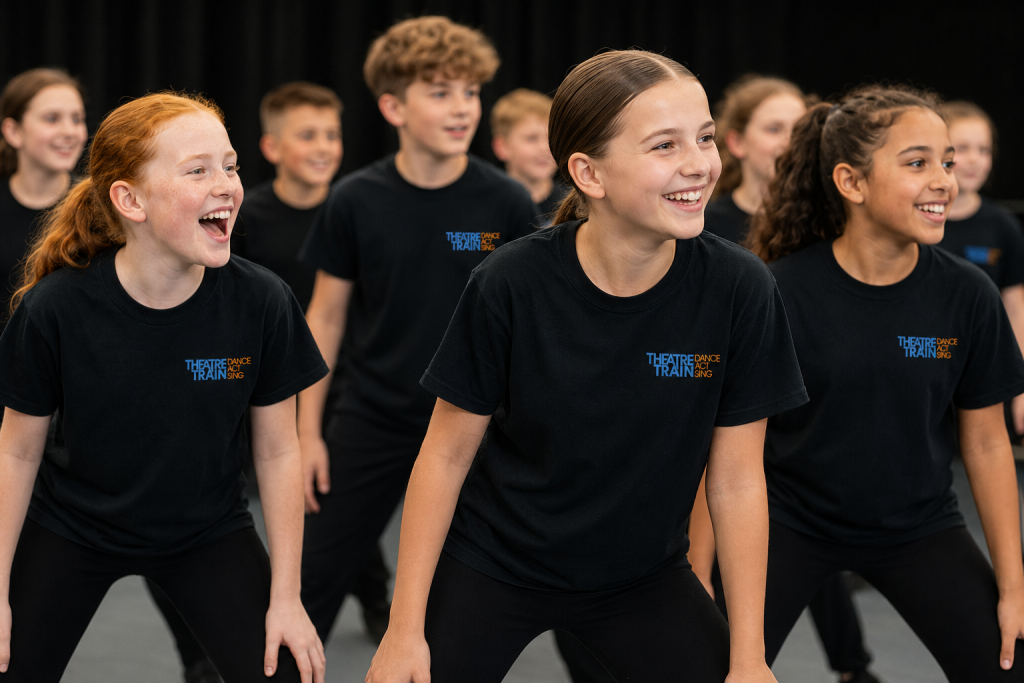
Take Theatretrain, for example. Each weekly session includes one hour each of singing, dancing, and acting—a balanced approach designed to build well-rounded performers. This structure isn’t just for variety’s sake; it reflects the demands of the industry itself. Whether a student ends up on the West End, in community theatre, or simply carries the skills into other areas of life, they’re developing versatility, discipline, and confidence through consistent, active engagement across all three areas.
That’s also why, at Theatretrain, we don’t just refer to our staff as teachers—we call them Creatives. Each centre is led by a Musical Director, Choreographer, and a Director of Acting. These are roles grounded in the professional performing arts world. They bring not only expertise, but also a genuine connection to the creative process—because they’re not simply delivering a lesson plan, they’re crafting experiences, guiding young performers, and helping shape original work. It’s a fundamentally different approach to what happens in a typical classroom.
Real performing arts classes, on the other hand, are led by people who live and breathe the industry—directors, choreographers, musicians, working artists—people who understand that theatre isn’t about ticking boxes; it’s about risk, connection, and energy. Their approach fosters an environment where creativity flourishes and young people are encouraged to explore, to move, to fail, and to try again.
In these classes, students aren’t waiting for their turn. They’re constantly involved—whether it’s warming up, devising in groups, giving feedback, or rehearsing as an ensemble. Everyone is learning, together. It’s in that space—active, inclusive, and unpredictable—that true growth takes place.
So yes, let’s keep secondary school drama. Let’s celebrate it as a spark, a starting point, an opportunity. But let’s also recognise that it can only take young people so far. And when it comes to LAMDA or curriculum-bound lessons, perhaps it’s time to ask whether they’re giving every child in the room a chance to truly engage.
Because if we want young people to thrive in the performing arts, we need to give them more than just a monologue and a score sheet. We need to give them a stage, a team, and the freedom to create.