Children spend a lot of time being asked for the right answer.
In school. In tests. In everyday life.
That has its place, of course. But children also need opportunities to explore, imagine and ask, what else could this be? They need spaces where ideas can be tried, shaped, changed and improved. That is where performing arts can be so valuable.
In acting, singing and dancing, children are not only copying instructions. They are making choices. They are solving problems. They are learning to trust their own thinking.
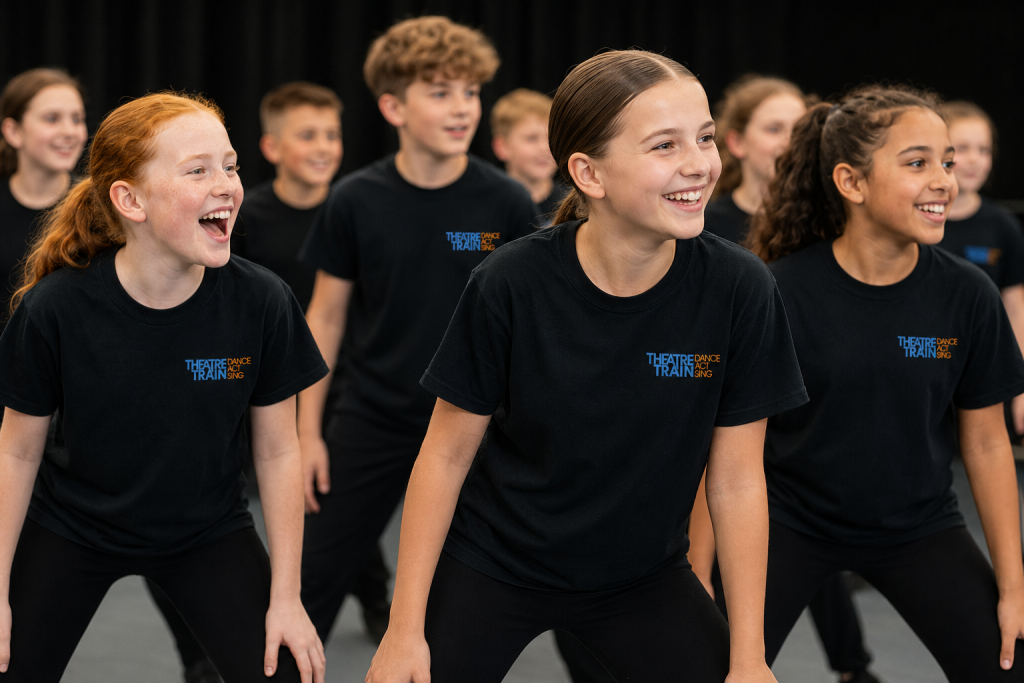
At Theatretrain Maldon, our performing arts classes help children develop creativity in a practical, active and confidence-building way. Not by sitting still and talking about being creative, but by doing it.
Creativity needs courage
Having an idea can feel risky for a child.
What if it is wrong? What if people laugh? What if someone else has a better one?
Performing arts helps children realise that ideas do not have to be perfect to be useful. A first idea might become the start of a scene. A movement might become part of a routine. A character choice might make the whole group laugh in the best possible way.
When children see that their ideas can contribute to something bigger, they begin to take creative risks. They start to understand that trying is not embarrassing. It is how things grow.
Thinking on your feet
A rehearsal room is full of quick thinking.
A line is missed. A cue changes. A group has to find a new formation. Someone forgets a move and the rest of the team keeps going. These moments are not disasters. They are opportunities for children to practise staying calm, adapting and finding a way through.
That is brave thinking in action.
Children learn that they can respond, not panic. They can make a choice, not freeze. They can keep going, even when something is not exactly as planned. These are the kinds of skills that travel far beyond the stage.
Imagination with structure
People sometimes think creativity is completely free and unstructured. In performing arts, children learn that creativity often works best with a framework.
A scene has a setting. A song has a rhythm. A dance has counts. A performance has a beginning, middle and end. Within that structure, children still have room to explore. They can decide how a character feels. They can use facial expression. They can bring energy, timing and personality to what they are doing.
This combination is important.
It teaches children that creativity is not chaos. It is decision-making. It is listening. It is noticing what works and improving what does not. It is using imagination with purpose.
Problem-solving without pressure
Performing arts gives children a practical way to solve problems as a team.
How do we make this scene clearer? How do we show excitement without shouting over each other? How do we make the audience understand the story? How do we move from one position to another safely and smoothly?
These questions might sound simple, but they encourage children to think deeply. They have to consider other people. They have to listen to direction. They have to try, review and try again.
Best of all, they do not always feel like lessons. They feel like rehearsal. They feel like play. They feel like creating something together.
Trusting their voice
When children are encouraged to think creatively, they begin to trust themselves more.
They learn that they can offer something. They learn that their view matters. They learn that ideas can be developed, rather than judged instantly. That can be especially powerful for children who are quiet, cautious or worried about making mistakes.
A child who starts by copying might eventually suggest. A child who starts by watching might eventually lead. A child who says, ‘I do not know,’ might begin to say, ‘Could we try this?’
That shift is wonderful to see.
A skill for life
Creative thinking is not only useful in performing arts. It helps children in school, friendships and everyday challenges. It helps them communicate, adapt and approach problems with more confidence.
The world needs young people who can think, listen, imagine and respond. Performing arts gives children a joyful way to practise those skills week after week.
At Theatretrain Maldon, we want children to feel proud of their ideas. We want them to know that their imagination has value. We want them to discover that brave thinking is not about always knowing the answer.
Sometimes, it is about being willing to try one.