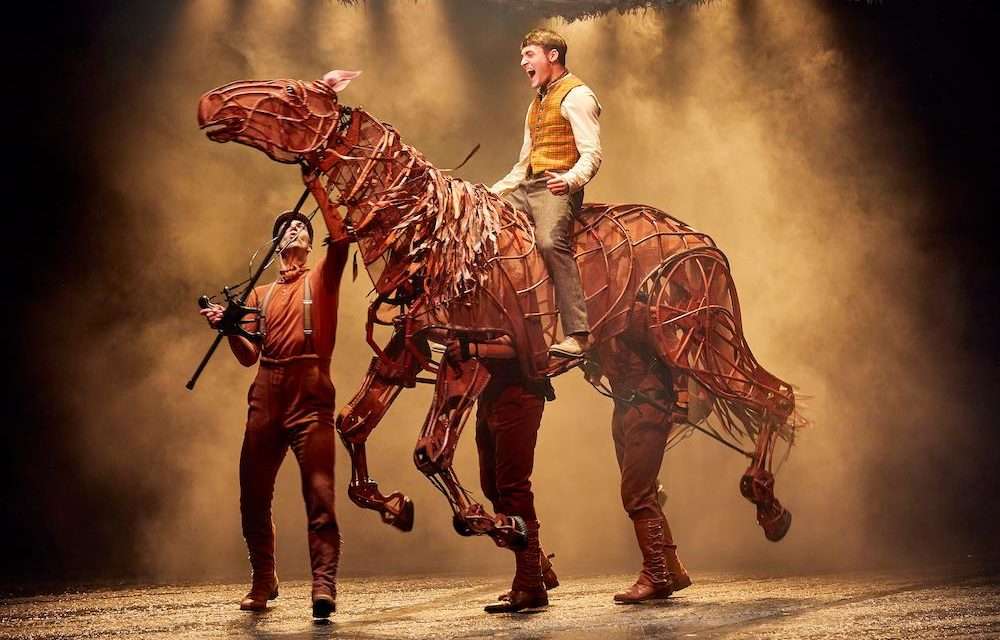
It’s a wonderful show, and a warhorse in another sense, in that it seems to have been constantly touring since 2007. I’m sure it is helping the finances of the National Theatre. It started life as a book by Michael Morpurgo, and when the National Theatre created the production, they turned to the award-winning Handspring Puppet Company. What magnificent horses they created, and Joey and Topthorn are brilliantly realised, each operated by three actors. There’s even a lovely Goose on a stick that never quite manages to get into the door of the farmhouse.
I originally saw this production about 15 years ago, and if anything, it is better now. The story is sometimes sentimental and mainly casts its characters as goodies or baddies, like the bullying uncle, but once we are into the war, we see that the enemy isn’t always painted as baddies. There is pathos and humour, music and passion. What is outstanding about this current production is the way they use pencil drawings and blocks of colour behind the action. At the back of the set is a large white cloth, but it looks as if it has been ripped from an artist’s sketchbook. So, when you see the fields of the countryside, a town square or the barbed wire landscape of No Man’s Land, it encourages you to bring your imagination to what is happening. That’s clever because you are already imagining the horses and other animals to be real – you build your own picture of it all and enter the world of the story. By the end, many people are in tears.
The afternoon I was there, it was well supported by young people. It’s one of those performances that stays in your memory long after the event. You catch a sense of how the world may have been over a hundred years ago. The main character is Albert Narracott, and we follow his deep love for his horse, Joey. They have little money, but Albert wins a bet from his uncle by getting Joey to pull a plough. Joey and Albert are separated by the war, find themselves in France and after many adventures, even in enemy territory, they are reunited. Although coincidences could strain belief, you go along with it because you also believe the horses and the scenery. It works.
I loved the way they told the story with a narrator talking directly to the audience, sometimes the pencil sketches tell us where we are or the time of year. A folk singer intervenes, and the actors turn objects like sticks into fences or barricades. We are constantly reminded that what we are watching is not real, but at the same time, we believe in it, and we see something deeper about us human beings and how we are with each other.
My grandfather was in the Royal Horse Artillery in the First World War, and I have a photo of him astride a glossy black horse, so I feel a personal connection to the story. You don’t need a connection to be drawn in, though, and the figures speak for themselves. War Horse has played in over 100 cities in 14 countries. That’s 8.8 million people worldwide. Then you could add the number of people who have watched Steven Spielberg’s film. The extraordinary power of story.