Why is creativity important for children?
October 16, 2026

Why is creativity important for children?

Why is creativity important for children? Because creativity isn’t only about being artistic or coming up with big ideas.

Sometimes it’s simply having the confidence to try something, change it and see what happens.

When we think about creativity in children, I think it’s easy to imagine the child who’s always full of ideas.

The one who’s constantly making things up, creating stories or putting on shows in the living room.

But I don’t think you have to be that child to be creative.

Sometimes creativity is simply being given a problem and having the chance to work out what you might do with it.

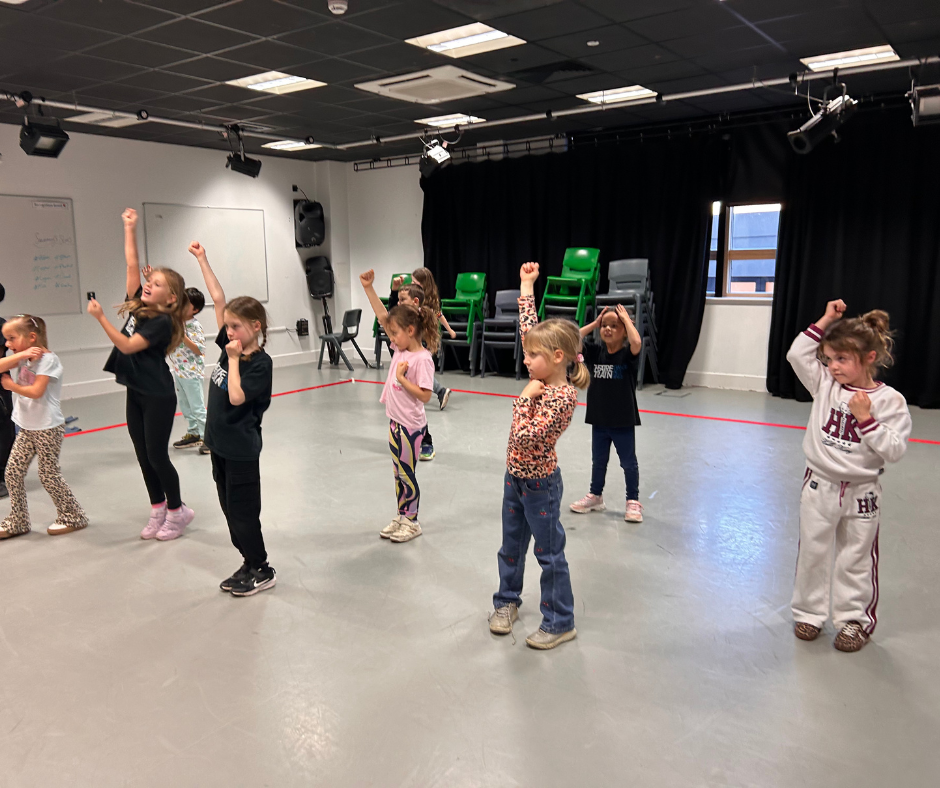
I was reminded of this recently when I walked into one of our dance classes.

Nobody noticed me.

Not one of them 😂

They were far too busy trying to find negative space.

What is negative space in dance?

Their teacher had given them a creative task around negative space.

They were working in pairs and looking for the empty spaces they could create between their bodies.

So, for example, one child might bend over into a crab position and the other could lie underneath them.

Once they’d found the negative space, they then had to work out how they could create movement around it.

There wasn’t a routine for them to copy.

There wasn’t one right answer.

They had to try things.

And they were completely absorbed in it.

Every time they discovered a new movement, they were desperate to show their teacher.

I stood watching them for quite a while and I loved the energy in the room.

Why do we give children creative tasks?

There are times in a dance class when I absolutely want the children to copy what their teacher is doing.

If they’re learning choreography, they need to watch carefully, remember the steps and work on getting them right.

Technique needs to be taught too.

But I don’t want that to be all they ever do.

If we’re always showing children exactly what to do, they get very good at following our ideas.

Sometimes I want to know what their ideas are.

That’s why I like giving children a starting point rather than always giving them the finished answer.

What could you do with this?

What happens if you try that?

Could you do it a different way?

Sometimes it works.

Sometimes it really doesn’t.

But that’s part of it.

What if my child doesn't think they're creative?

I think this is quite an important one.

Some children will immediately have twenty ideas.

Others won’t.

That doesn’t mean they’re not creative.

They might need to watch what somebody else does first.

Someone in their group might suggest something and they suddenly think of a way to add to it.

They might try something, decide they don’t like it and change it.

For me, that’s all creativity.

You don’t have to be the loudest person in the group or the person who comes up with the original idea.

Sometimes your contribution is the little thing that makes somebody else’s idea work.

Can creativity be learnt?

I think children can definitely get more comfortable with being creative.

If you’re used to being given the answer, being asked “What do you think?” can actually be quite difficult.

There’s suddenly no right thing to say.

But the more opportunities children have to come up with ideas, try them and change them, the more normal it becomes.

And I think it’s important that they know their first idea doesn’t have to be brilliant.

We can try it and see.

If it doesn’t work, we’ll try something else.

Creativity isn't only part of drama

I think people probably expect children to be creative in drama.

They’re making up characters and stories, so the connection is quite obvious.

But creativity in children can show up across all three of our disciplines.

It might be deciding how a character would react in drama.

It could be thinking about how to perform a song rather than simply singing the notes.

Or it could be a room full of dancers trying to work out how many different ways they can fill the space around each other’s bodies.

That’s one of the things I love about performing arts.

There’s a time for being taught.

There’s a time for practising something until you can do it.

And there’s also a time for being given some space and seeing what you come up with.

They didn't want to stop

When that dance class finished, the children didn’t want to leave.

They were convinced there was still more negative space they could find!

And I think that tells you quite a lot.

Nobody had asked them to come up with the “best” idea.

There wasn’t a prize for finding the most negative space.

They were just completely caught up in seeing what else they could create.

I really believe a dance class should involve your whole being, your soul, not just the steps.

Watching that class, I think that’s exactly what was happening.

Find out more about our

amazing performing arts classes here

Theatretrain Hitchin

Saturdays 

Hitchin Girls School

9.30am-12.30pm

Theatretrain Letchworth

Saturdays 

St Christopher’s School

9am-12pm

Theatretrain Stevenage

Saturdays 

Marriotts School

1.30pm-4.30pm

Theatretrain, a nationwide provider of weekend theatre schools for young people aged 4-18, specialises in weekly classes in acting, singing, and dancing. An emphasis is placed on learning valuable life skills such as confidence, empathy, courage, and resilience. If you know a child who loves to dance, act and sing or could do with a little confidence boost why not visit to find out what our performing arts classes can offer your child at one of our 80 locations across the UK.

Related Articles

What Are the Pros and Cons of Theatretrain?

What Are the Pros and Cons of Theatretrain?

If you’re thinking about Theatretrain for your child, I could give you a very long list of reasons why I think it’s brilliant. I’ve been part of Theatretrain for years, so obviously I’m not completely neutral! But I also don’t think it’s helpful to pretend there are no downsides. Every children’s activity has things that will suit some families brilliantly and things that won’t work for others. So if you’re trying to decide whether Theatretrain is right for your child, here are what I think are the genuine pros and cons.
Read more >
Is Theatretrain Right for Every Child? 7 Reasons It Might Not Be

Is Theatretrain Right for My Child? 7 Reasons It Might Not Be

I’m going to say something that probably sounds a bit odd coming from someone who runs Theatretrain. Theatretrain is not right for every child. And I think it’s really important to be honest about that. Of course, I want children to come along, enjoy it and hopefully stay with us for years. But I’d much rather tell you that Theatretrain might not be the right fit than persuade you to join and have your child miserable a few weeks later.
Read more >

Performing Arts School vs Dance School: Which Would Suit My Child?

If your child loves performing, you might find yourself choosing between a performing arts school and a dance school. At first glance, they can look quite similar. There may be music. There may be performances. There will probably be lots of energetic children coming out at the end! But the experience your child gets can be quite different. Neither is necessarily better than the other. The important question is: Which one is the better fit for your child?
Read more >
A child standing at the back of a performing arts class before gradually building the confidence to join in.

How Do Children Build Confidence?

Some children stand at the back of the room when they first arrive. They aren't trying to avoid joining in, they're trying to feel safe. The lovely part is watching what happens next.
Read more >